Summary
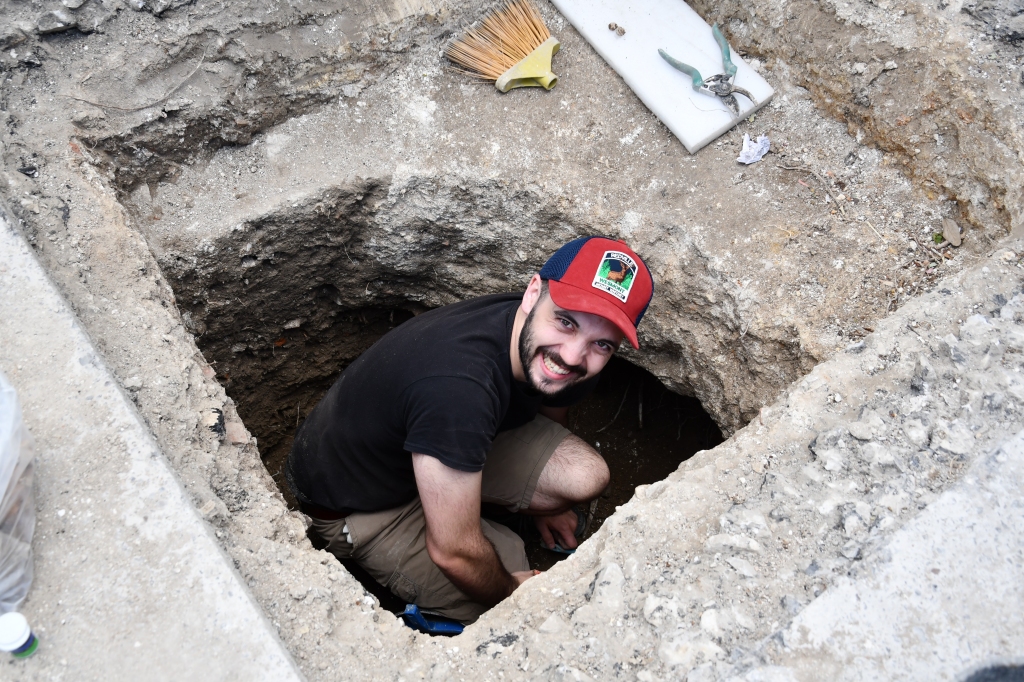
Dr. Trent Trombley of Augustana University joins the show to talk about his research at Villamagna, a medieval settlement outside of Rome. He uses macroscopic analysis of teeth along with a few other methods to understand life in the past.
Recommendations
- Dr. Trombley’s ResearchGate profile
- Trombley TM, Agarwal SC, Beauchesne PD, Goodson C, Candilio F, Coppa A, Rubini M. Making Sense of Medieval Mouths: Investigating Sex Differences of Dental Pathological Lesions in a Late Medieval Italian Community. Am J Phys Anthropol. 2019 Jun;169(2):253-269.
- Trombley, Trent & Beauchesne, Patrick & Agarwal, Sabrina & Kinkopf, Katherine & Goodson, Caroline & Candilio, Francesca & Coppa, Alfredo & Rubini, Mauro. (2023). Growing up at Villamagna: Sex, Gender, and Stress During Growth and Development in a Medieval Italian Community. Bioarchaeology International. 10.5744/bi.2022.0022.
- BioAnthropology News Facebook Group
- T Smith. (2018). The Tales Teeth Tell: Development, Evolution, Behavior. MIT Press.
- R Barnett. (2017). The Smile Stealers: The Fine and Foul Art of Dentistry. Thames & Hudson.
- Dr. Simon Hillson’s books on dental anthropology
- K Gannon. (2020). Radical Hope: A Teaching Manifesto. West Virginia University Press.
- A Fuentes. (2022). Race, Monogamy, and Other Lies They Told You: Busting Myths about Human Nature. University of California Press.
- C Liu (translation J Martinsen). (2019). Ball Lightning. Tor Books.
- C Liu (translation J Martinsen & K Liu). (2019). The Three-Body Problem Series. Tor Books.
- D Simmons. (1990). Hyperion. Spectra Books.
- Becky Chambers books
- R Nayler. (2023). The Mountain in the Sea. Picador USA.



 AnthroBiology Podcast