Summary
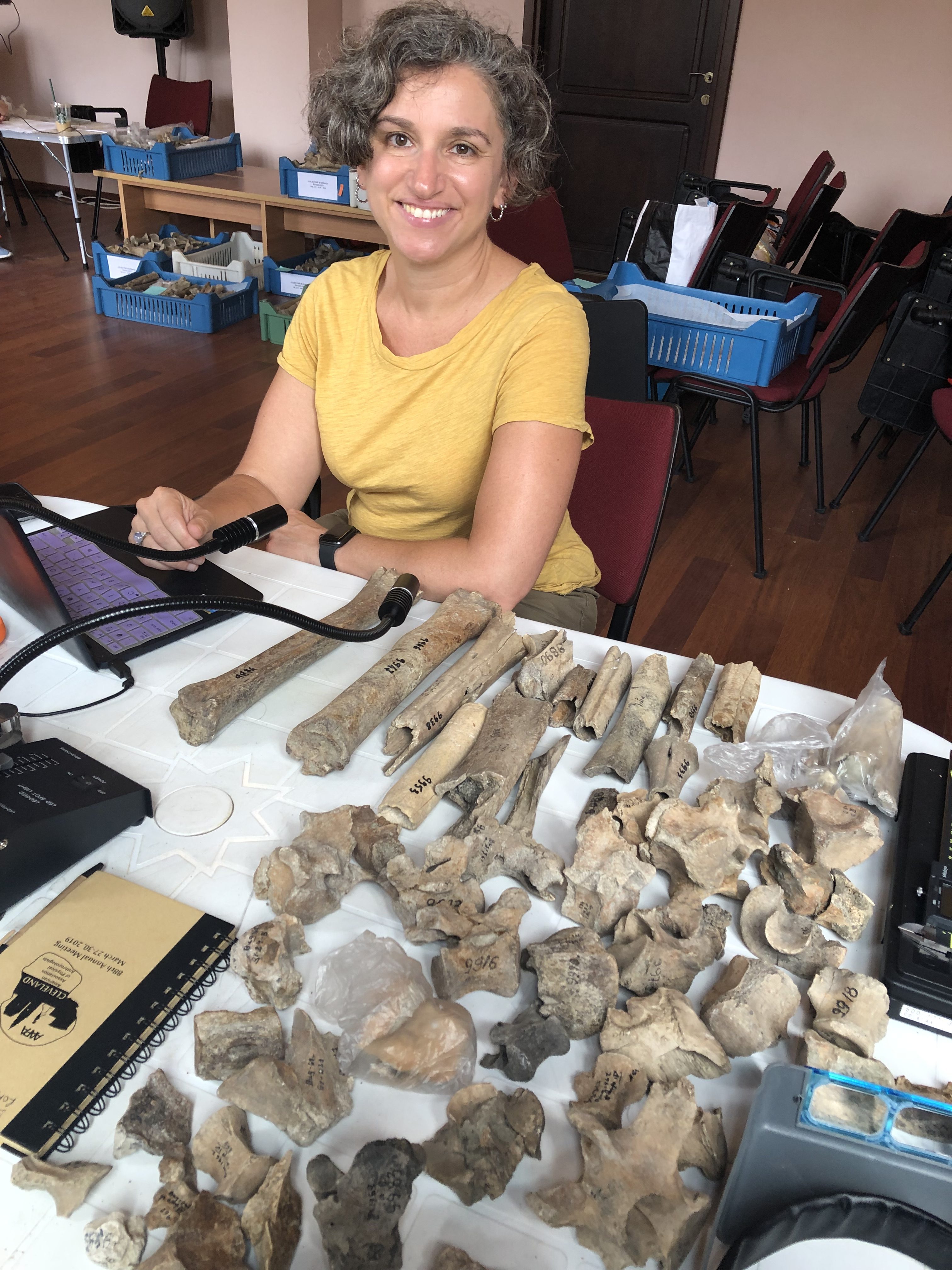
Dr. Briana Pobiner of the Smithsonian National Museum of Natural History’s Human Origins Program joins the show to talk about cut marks. She discusses how we can tell what’s a cut mark vs. other bone damage and how cut marks can illuminate human evolution along with illustrating migration and behavioral patterns in the distant past.
Recommendations
- Dr. Pobiner’s NMNH staff profile
- Dr. Pobiner’s Google Scholar profile
- W.A. Barr, B. Pobiner, J. Rowan, A. Du, & J.T. Faith. (2022). No sustained increase in zooarchaeological evidence for carnivory after the appearance of Homo erectus, Proc. Natl. Acad. Sci. U.S.A. 119 (5) e2115540119, https://doi.org/10.1073/pnas.2115540119.
- Keevil TL, Pelissero AJ, Negash T, Orlikoff ER, Osborne I, Tolley AM, Pobiner B and Pante MC. (2026). A comparative bone surface modification database for revealing the origins and evolution of human carnivory. Front. Ecol. Evol. 14:1681814. doi: 10.3389/fevo.2026.1681814
- Pobiner, B., Pante, M. & Keevil, T. (2023). Early Pleistocene cut marked hominin fossil from Koobi Fora, Kenya. Sci Rep 13, 9896. https://doi.org/10.1038/s41598-023-35702-7
- Egeland, C., Pobiner, B., Merritt, S., & Kunitz, S. (2024). Actualistic butchery studies in zooarchaeology: Where we’ve been, where we are now, and where we want to go. Journal of Anthropological Archaeology. 73. 10.1016/j.jaa.2023.101565.
- Curran, S.C., Drăgușin, V., Pobiner, B. et al. Hominin presence in Eurasia by at least 1.95 million years ago. Nat Commun 16, 836 (2025). https://doi.org/10.1038/s41467-025-56154-9
- Pobiner, B., Curran, S., and Drãgușin, V. (2025). Tiny cut marks on animal bone fossils reveal that human ancestors were in Romania 1.95 million years ago. The Conversation. https://doi.org/10.64628/AAI.vxf9wp6jy
- Pobiner, B. (2016). Meat-Eating Among the Earliest Humans. American Scientist. 104 (2).
- The Bear (TV show)
- Miller, L. (2021). Why Fish Don’t Exist: A Story of Loss, Love, and the Hidden Order of Life. Simon & Schuster.


